- Home
- Running Injuries
Running Injuries: What to Do, When to Seek Help and How to Return
By Andrew Greenhalgh Updated August 2026
Running injuries can affect new runners, experienced runners and people returning after a long break - but pain does not always tell you exactly what is wrong or what you should do next. If you have developed a new ache, keep meeting the same problem or are trying to rebuild after time away, this page will help you decide on the next sensible step.
Here you will find a clear guide to common problems, warning signs, early management, gradual recovery and reducing future risk. It will also direct you to our more detailed injury pages where a subject needs closer attention.
At My Running Tips, we dig beneath quick fixes and familiar rules to examine what the research actually supports. That means acknowledging uncertainty: no single shoe, stretch, foot strike or training formula can protect every runner, and an online page cannot diagnose the cause of your pain.
Note: This page provides general educational information, not a diagnosis or an individual treatment plan

Why Running Injuries Happen
It is tempting to blame one thing: the wrong shoes, poor form, weak glutes or doing too much too soon. In reality, running pain is usually more complicated. Injury can develop when the stress placed on a tissue exceeds what it is currently able to tolerate, but that balance is affected by training history, previous injury, recovery, sleep, nutrition, health, work and everyday life.
A 2024 umbrella review of running-injury research concluded that risk factors remain difficult to pin down consistently. Previous injury appears repeatedly, while many other associations vary between studies and groups of runners. That is why confident claims about one universal cause should be treated cautiously.
Training still matters. A sudden outlier run - much farther, faster or hillier than your recent work - may present more stress than your body is ready to absorb. A large 2025 cohort study found that single-session distance spikes were associated with greater injury risk, while traditional week-to-week mileage calculations were less informative. That finding is useful, but it is not a new rule that can predict every injury.
- Training changes: distance, speed, hills, terrain and frequency can interact rather than acting separately.
- Previous injury: an area that has not fully recovered may have less capacity when training rises again.
- Recovery and health: poor sleep, inadequate fuelling, illness and heavy physical or emotional stress can affect how well training is absorbed.
- Strength and movement capacity: these may matter for a particular runner, but weakness or a movement pattern should not automatically be presented as the single cause.
- Sudden equipment or technique changes: even a potentially useful change can create unfamiliar loading if introduced too quickly.
The practical lesson is not to become frightened of training. It is to build work your body can absorb, notice significant changes and avoid treating a general guideline - including the old 10% weekly rule - as a guarantee.
When Pain Means You Should Stop Running
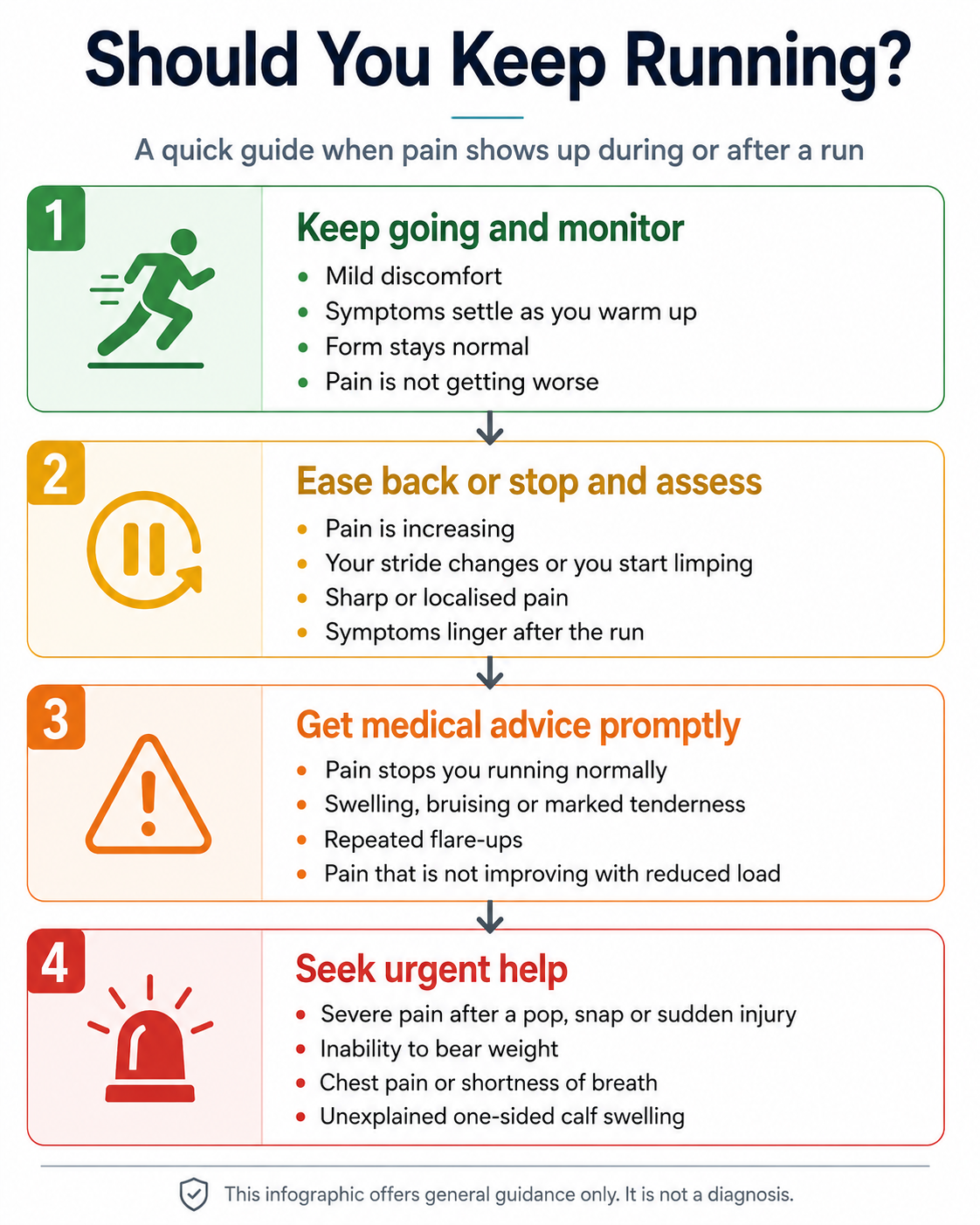
Not every sensation during a run is an injury. Mild stiffness, ordinary post-exercise soreness and a brief ache that settles may not mean tissue damage. Equally, repeatedly pushing through pain because it is not yet severe can allow a manageable problem to become more difficult. The pattern matters.
Stop the run and reassess if pain is sharp, increasing, changes your stride, makes you limp, returns earlier on each run or remains after you stop. Sudden weakness, a snap or pop, visible swelling, or very localised pain over a bone also deserves caution. Do not use painkillers to disguise pain so that you can finish the session.

Running Tips HQ: Seek urgent medical help if: you cannot walk or put weight on a joint after an injury; the joint or limb looks deformed; you have severe pain, numbness or tingling; or a painful joint is hot and swollen and you feel feverish or generally unwell. In the UK, use NHS 111 for urgent advice.
These signs are not a complete diagnostic list. If something feels substantially different from your usual running aches - or you are uncertain - getting it assessed is the sensible choice.
Common Running Injuries
The knee, lower leg, ankle and foot are among the areas most often affected in runners, but the same location can have several possible causes. Use the summaries below as signposts rather than a self-diagnosis.
Runner's knee or patellofemoral pain. Pain is usually felt around or behind the kneecap and may be aggravated by running, stairs, squatting or sitting with the knee bent. It does not automatically mean the cartilage has worn away. Read our runner's knee guide or the broader knee pain guide.
Achilles tendinopathy. Pain or stiffness is felt in the tendon behind the ankle, often first thing in the morning or near the beginning of activity. A sudden sharp pain with loss of function may indicate something different and needs prompt assessment.
Shin pain and bone stress injury. The term shin splints is often used for exercise-related pain along the shin, but very localised tenderness, swelling or pain that progresses into walking may raise concern about a bone stress injury. Our stress fracture guide explains why proper assessment matters.
Plantar heel pain. Pain is normally felt beneath the heel or into the arch and is often worse during the first steps after rest. Several factors can contribute, so footwear alone should not automatically be blamed.
Iliotibial band-related pain. This is usually felt on the outside of the knee and can appear predictably after a certain distance. It may be influenced by recent training changes as well as the runner's individual strength and movement demands.
Muscle strains and ankle sprains. A strain often produces sudden pain in a muscle such as the calf or hamstring. A sprain affects a ligament, commonly after the ankle twists. The severity and loss of function matter more than the label guessed at home.
Exercise-associated muscle cramps. Cramp is not usually classified as an injury, but it can stop a run and may be associated with fatigue and the demands of the event. The causes are more complex than simply lacking water or magnesium. Read our running cramps guide
What to Do When Pain Starts
The first response should match what has happened. A traumatic ankle twist, gradual tendon pain and possible bone stress are not the same problem, so one four-letter treatment formula cannot manage them all.
- Stop or modify the aggravating activity. Do not keep testing the same painful movement every few minutes. If you cannot move normally, stop the session.
- Protect the area when necessary. A significant acute injury may need temporary support or reduced weight-bearing, but prolonged complete rest can also reduce capacity. Seek advice when you are unsure.
- Use symptom relief carefully. Wrapped ice may provide short-term pain relief after some acute injuries; elevation may help swelling. Ice should not be placed directly on the skin or used where sensation or circulation is impaired.
- Introduce comfortable movement when appropriate. Current NHS ankle-sprain guidance encourages gentle early movement and weight-bearing as comfort allows, rather than keeping every minor sprain completely immobile.
- Work out what needs changing. The useful question is not merely how to settle pain today, but which training or recovery factors need addressing before the same load is repeated.
The familiar RICE method - rest, ice, compression and elevation - can describe short-term symptom-management options for some acute injuries. It should not be presented as a universal treatment, a cure or proof that healing will happen faster.
Returning to Running After Injury
Returning successfully is not just a matter of waiting a fixed number of days. The cause and severity of the problem, your previous training, present symptoms and the demands of the next run all matter. Bone stress injuries, fractures, significant tears and recurring problems require individual professional guidance.
Before testing a return, look for practical signs of readiness:
- ordinary walking and daily activities are comfortable and you are not limping;
- pain and swelling are stable or improving rather than worsening;
- the affected area can tolerate the strength and movement demands advised for your particular injury;
- you understand the likely contributing factors and have a plan to address them;
- you are prepared to stop or step back if symptoms progressively increase.
A gradual walk-run progression often provides a controlled way back. Begin below the level you believe you could force yourself through, keep the early running easy and increase duration or distance before adding speed, hills and demanding sessions.
Change one main variable at a time and judge the response later that day and the following morning, not only while adrenaline is carrying you through the run.

When Achilles tendinopathy stopped me running for six months in 2009, the experience changed how I thought about recovery. During that time, I trained for the Manchester to Blackpool bike ride, using cycling as a lower-impact way to maintain fitness before gradually returning to running. I stopped seeing injury as a pause followed by an immediate return to the old routine; rebuilding strength and fitness became part of the recovery process. That experience gives me context, but it is not proof that the same approach will suit every runner or every injury.
The best return is repeatable. One encouraging run does not mean the body is ready for the training load that preceded the injury.
Reducing Your Risk of Running Injuries
No honest website can promise injury-free running. Prevention is better understood as improving capacity, controlling avoidable spikes and responding intelligently when something changes. Even well-designed exercise programmes have produced mixed results in running-specific research, which is another reason to avoid guarantees.
- Build continuity before ambition. A training level you can repeat and recover from is more valuable than occasional heroic sessions.
- Treat outlier sessions with caution. Be particularly careful when one run is much longer, faster or hillier than anything completed recently.
- Use strength training to build capacity. Strength can support performance, bone health and rehabilitation, but no generic routine prevents every running injury. Start with exercises appropriate to your present level and progress them. See our strength training for runners.
- Allow adaptation. Recovery days, sufficient sleep and enough energy and protein are part of training, not signs that training has stopped.
- Choose footwear without magical claims. A Cochrane review found no clear evidence that prescribing shoes from static foot posture reduces injury. Comfort matters, and substantial changes in cushioning, drop or running style should be introduced gradually.
- Change form for a reason. There is no single perfect running form. Gait changes can help some injuries when targeted carefully, but forcing every runner into the same foot strike or cadence may simply move the load elsewhere.
- Respond early. A recurring pattern is information. Reduce the provoking load and investigate it instead of repeatedly proving that it still hurts.

Explore Common Running Injuries
If you are dealing with a specific problem, these guides look more closely at symptoms, possible causes and recovery:
How we research running injuries.
We prioritise NHS and other recognised clinical guidance for warning signs and patient safety, then use systematic reviews, consensus work and original research to examine training, prevention and return to running. Where findings conflict or evidence is limited, we say so. Personal experience may add context, but we never treat it as proof.
Running well for longer is not about becoming unbreakable. It is about noticing changes, responding early, rebuilding patiently and making decisions that fit the runner in front of you. That is the purpose of this hub: clearer choices, fewer myths and stronger foundations for dealing with running injuries.
References
NHS: Joint pain - Urgent warning signs, movement and symptom-management advice. Page reviewed February 2026.
NHS: DVT (deep vein thrombosis) - One-sided leg symptoms and emergency chest-pain/breathlessness advice.
NHS: Knee pain and other running injuries - Patient-facing information on knee, Achilles, shin, heel and muscle pain.
University Hospitals Sussex NHS: Ankle sprain - Short-term cold therapy, early movement, weight-bearing and escalation advice.
Correia et al. (2024): Risk factors for running-related injuries - Umbrella systematic review of risk-factor evidence.
Kakouris et al. (2021): Running-related musculoskeletal injuries - Systematic review of commonly affected sites and conditions.
Frandsen et al. (2025): How much running is too much? - Prospective cohort study of session-specific distance changes in 5,205 adult runners.
Wu et al. (2024): Exercise-based prevention programmes - Systematic review and meta-analysis finding no significant pooled reduction in running-related injury risk or rate.
George et al. (2024): Return to running after tibial bone stress injury - Scoping review supporting criteria-based, individualised walk-run progression for bone stress injury.
Cochrane (2022): Running shoes for preventing lower-limb injuries - Evidence review on shoe types and prescription based on foot posture.
RICE Method is only the beginning
Rest, ice, compression and elevation may help early symptoms, but recovery usually needs gradual movement and rebuilding too.
📚 Injury-Free Running Tips: Packed with must-know advice for beginner runners and essential checklist for seasoned pros (more)
