- Home
- Running for Beginners
Running for Beginners: A Practical Guide to Getting Started
By Andrew Greenhalgh Updated October 2026
Running for beginners can open the door to years of enjoyment, even if your first outing is mostly walking. Whether you are trying it for the first time or returning after a long break, start with what you can comfortably manage and give yourself time to build fitness and confidence.
Here you will find:
- Run-walk intervals to help you get started.
- Easy pacing advice and a manageable weekly routine.
- Simple warm-up and cooldown routines.
- Guidance on breathing, treadmill running and choosing shoes.
- Common beginner mistakes and how to avoid them.
- Links to in-depth guides when you are ready for your next step.

When I think about running for beginners, I recollect my own unexpected start in 2001. My bike needed repairing, and I had recently taken up cycling to get fitter and lose some weight. I wanted to maintain my fitness, so I reluctantly put on my trainers and tried running instead.
Until then, I associated running with school cross-country, when asthma frequently left me walking near the back. I had never thought of running for pleasure. But that first quarter-mile outing surprised me: I enjoyed it and came home wanting to run again.
Think beyond the first finish line
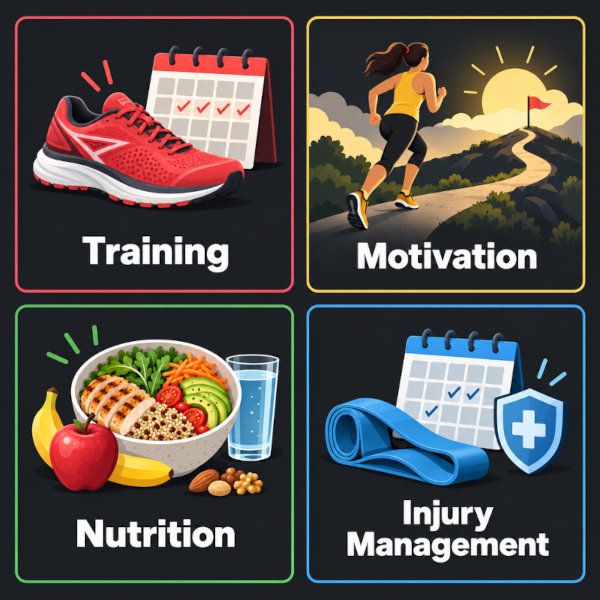
Your first 5k can be a great target, and it may be the beginning of something that remains with you for many years. It is worth preparing for that possibility from the start. On My Running Tips, I organise that preparation around Four Foundations: Training, Motivation, Nutrition and Injury Management. Even as a beginner, it is worth thinking ahead. These Four Foundations help you build fitness, stay motivated, fuel your running and recognise when to recover or adapt—so you can avoid common pitfalls as your running adventure unfolds.
There is plenty to learn, but you can discover it as you go. Start with outings you can comfortably manage, giving yourself time to build confidence and enjoy running. For a little more structure, explore Running Training Plans and choose a program that fits your current fitness and goals.
Before you begin: This guide to running for beginners offers general advice. If you have health concerns, speak to your GP before starting. If you are returning after an injury, follow the advice given for your recovery—a beginner running program is not a substitute for an individual rehabilitation plan. [1, 6]
Run-walk
intervals for beginners
Walking breaks are a useful part of a runner’s toolkit, helping you start with short, manageable running efforts. The NHS Couch to 5k program alternates running and walking to build up gradually. It is an established approach to running for beginners. [1]
When I returned to running in 2006, we were living beside the Ashton Canal in Droylsden. With the towpath on our doorstep, I was eager to get going again—but after about 150 yards, I was already struggling for breath.
I did a bit of Googling and found an eight-week Couch to 5k program. Its first session was 1 minute walking followed by 2 minutes walking. Those walking breaks made the outing enjoyable for me: I could settle between the running efforts instead of struggling continuously, and this built my confidence. During the following weeks, I ran for longer and eventually completed 5k without stopping, in just over 31 minutes.
That was my program, not a session everyone needs to complete on day one. Choose a starting level that fits you, and let the running portions stay gentle.
I have returned to run-walk sessions after injury setbacks, and I still use walking breaks on longer outings and steep trails.
Julie hadn’t run regularly for a few months when we headed out for a walk. Along the way, she suggested mixing in some running. We walked the steep climbs and alternated running and walking on the easier stretches. She enjoyed it so much that we went much farther than usual. Her thighs were sore the next day, so afterwards she kept to shorter outings of two or three miles. It was lovely to see her enjoying running again, but the lesson applies to running for beginners too: leave yourself something for the next outing, even when enthusiasm tempts you to keep going.

Easy
pace for new runners
On your early outings, notice how easily you can talk. The CDC’s “talk test” describes moderate effort as being able to talk but not sing. At vigorous effort, you may manage only a few words before needing a breath. Use this as a simple guide to how hard you are working; it does not prescribe a pace or assess your health. [2]
For an easy run-walk outing, I would use that cue conservatively: if speaking comfortably becomes difficult, ease back or walk.
Running Tips HQ:
If you are going to talk to yourself (assuming you are not singing) why not use an affirmation: I- Can- Do- This (1-2-3-4) as your foot strikes the ground.
| What you notice | A useful response |
|---|---|
| You can speak comfortably and feel in control | Keep the effort steady; there is no need to speed up. |
| You can manage only a few words between breaths | Slow down or take a walking break. |
| A hill makes your usual pace feel much harder | Let your speed fall; walk if that keeps the effort manageable. |
I often set off too quickly, only noticing when I checked my watch or began to tire. Later, running in the hills around Bacup and Lee Quarry helped me appreciate a gentler pace. I became less concerned with the numbers on my watch and more interested in enjoying the landscape around me.
That is an approach I wish I had appreciated earlier. Choose an effort you can manage today, even when the number on your watch looks slower than you expected.
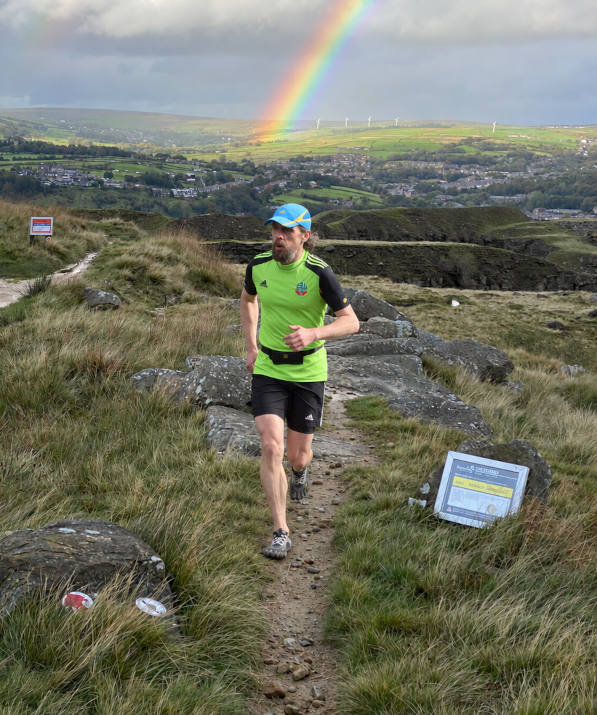
The hills around Lee Quarry helped me appreciate an easier pace.
How often should beginners run?
The NHS beginner program uses three sessions a week, with a rest day between runs. Treat it as a useful model, with room to adapt to your starting point and recovery. [1]
Here is how that spacing could look. It illustrates a weekly rhythm, not a complete training program.
| Day | Example rhythm |
|---|---|
| Monday | Beginner run-walk session |
| Tuesday | No running; rest or comfortable everyday movement |
| Wednesday | Beginner run-walk session |
| Thursday | No running; rest or comfortable everyday movement |
| Friday | Beginner run-walk session |
| Saturday | No running |
| Sunday | No running; leave space before Monday’s outing |
In 2001, I was so pleased to discover I could run that I went out every day, with no plan and little thought for recovery. Following a program in 2006 gave me more structure: days off were part of the schedule, helping me build a regular habit without running every day.
That is how I would approach it now: put recovery days in the diary alongside your runs. If life interrupts the week, move a session rather than squeeze missed outings together. Let the schedule help you build a habit, while allowing space for extra recovery when you need it.
Running
for beginners: a simple warm-up routine
Give yourself a transition from everyday activity into running. A five-minute walk is the starting warm-up used in the NHS beginner plan. [1]
Use those first few minutes of walking to ease into the outing, make sure your shoes feel comfortable,, and gradually pick up your pace. When you begin running, keep the effort gentle.
A short walking warm-up is a simple starting point for running for beginners. It helps you ease into the session, but feeling warmed up is not a reason to push the pace or add distance. Stick to a manageable outing, even when you feel full of energy.

A
beginner cooldown routine
Finish with a gentle walk and let the outing wind down. The NHS plan includes a five-minute cooldown walk. [1]
No need to attach extravagant promises. A research review found little support for many commonly claimed benefits of active cooldowns, including preventing delayed muscle soreness or injuries. [4]
I suggest using the finish to notice how the session went. Was the opening too quick? Did the walking breaks feel long enough? Is there any discomfort you need to watch for before another run? A brief note can be more useful than recording distance alone.
Running
for Beginners: Breathing Basics
Breathing was central to my early relationship with running. Asthma made school cross-country miserable, and years later that breathless restart beside the canal knocked my confidence.
When I returned to running in 2006, walking between short runs gave me time to catch my breath and made the outing more enjoyable. That helped me, but it does not mean every breathing difficulty is simply a matter of pace or fitness.
If you are struggling for breath, slow down or take a walking break. Let your breathing come naturally, through your nose, mouth or both—you do not need to learn a special technique before you start running.
If exercise brings wheezing, coughing or chest tightness, especially if you have asthma, seek advice from your GP or asthma nurse. Asthma + Lung UK advises getting symptoms assessed and following your asthma management advice. A pacing cue cannot tell you whether a symptom is medically safe. [3]
Treadmill
running for beginners
A treadmill can make running easier to fit into everyday life, especially when poor weather, dark evenings, or a lack of suitable routes make getting outdoors difficult.
Before your first session, ask someone to show you how the machine works. Find the speed controls and stop button, attach the safety clip as instructed, and begin at a comfortable walking speed. Increase the speed gradually as you get used to the moving belt. [7]
Choose a pace that feels manageable and take walking breaks when you need them. The runner beside you (if in a gym) may have years of experience, so let your own effort guide the session.
I have used treadmills throughout my running years. Being able to adjust the speed and time each interval makes them useful for following a run-walk program and keeping an outing simple (and there are no hills!).

Running
shoes for beginners
Running shoes range from cushioned and stability models to low-drop and minimalist designs. Start with a comfortable fit and footwear suited to where you plan to run. Research has not established one shoe category that prevents injuries for everyone, so be cautious about promises attached to particular designs. [5]
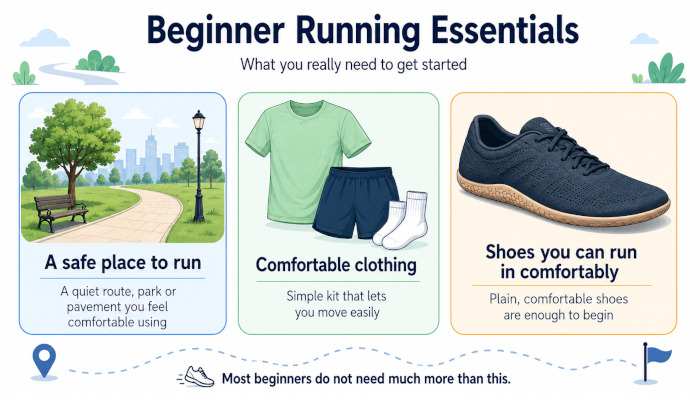
I personally favour minimalist footwear because I enjoy the natural feel. My runner’s knee hasn't returned since I switched, although that experience alone cannot tell us why or prove the shoes prevented it. Comfortable clothing, a suitable route, and a way to track your intervals complete a simple starting setup. You can make more specialised choices as you learn what you enjoy.
When you're running for the first time, your body is adapting to a new activity, no matter what shoes you choose. You can build up gradually from the outset, without also changing a long-established running-shoe habit. If you choose minimalist shoes, let your feet, calves, and Achilles adjust to their particular demands. Start with short, manageable outings and walking breaks, and use how you feel during and after each session to help guide your progress.
Common
mistakes in your first month of running
My first attempt at running was driven almost entirely by enthusiasm. One mile became two, then three, and one day I extended a three-mile route to five because I felt good. I treasure discovering what I could do, but my advice on running for beginners now includes more structure and patience than I gave myself.
Watch for starting too quickly, adding distance too soon, squeezing sessions together and pushing towards a target date despite discomfort. One more mistake is assuming that an early niggle means running will never suit you. Take pain seriously and give yourself time to recover, seeking advice if it persists or concerns you. A setback doesn't have to mean giving up altogether.
Fitness and strength develop over time, and learning when to progress, repeat a manageable week, or rest is part of becoming a runner. That patience can help you build a routine that lasts well beyond your first goal.
If something hurts, do not use the schedule as permission to keep running. NHS guidance advises against running through pain and recommends appropriate assessment for persistent or concerning symptoms. The Running Injuries hub can help you find further information. [6]
Allow extra time when planning towards an event, so a setback doesn't leave you rushing to catch up. If your calf is still tender, the approaching race date is no reason to push through. Adjusting your plan or choosing a later event gives you time to recover and keep working towards your goal.
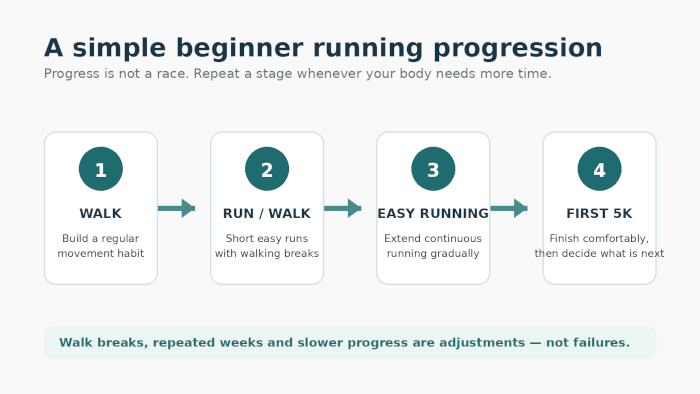
Let your next step grow from the routine you have built.
A first step with room to grow
After my 2006 rebuild, regular two- to three-mile runs became part of life alongside cycling and walking with Julie. Later, I entered my first 10k event—Alice’s Run in Hebden Bridge—to raise money for Epilepsy Research UK. Julie was going through a difficult period with her epilepsy, so the goal had a very personal meaning.
Having an event to work towards gave my training direction and a reason to keep making time for it. That is where Motivation, one of the Four Foundations, can make a difference: a goal you care about helps turn good intentions into a regular habit. Yours might be a first 5k, a charity event or simply reaching the end of a favourite route.
That first event led to others, and running became a lasting part of my life. When I first put on my running shoes, I had no idea where those first few steps would take me. Your beginning can be just as simple—a short outing today could start many years of enjoyable running.
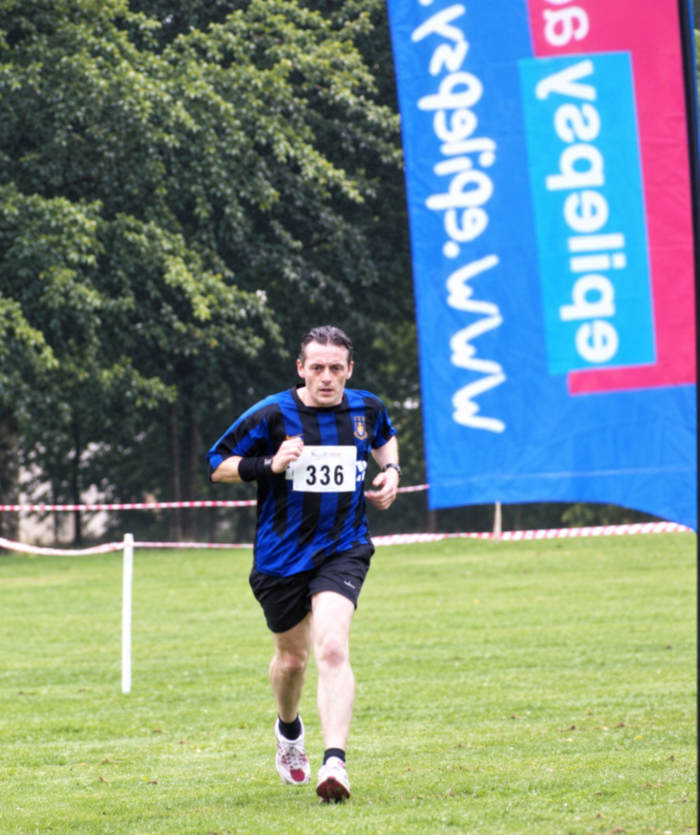
Running for beginners is about more than reaching your first 5k. It is a chance to discover something you can enjoy for years. Start with manageable outings, build confidence as you go and give yourself time to find a routine that fits your life.
For your next step, explore Running Training Plans to choose a program suited to your starting point. Keep the Four Foundations—Training, Motivation, Nutrition and Injury Management—in mind as your running develops. There is plenty to discover beyond that first finish line.
Here’s to your first outings—and all the discoveries ahead. I hope running earns a place in your life, as it has in mine.
Andrew
References
for this page:
1. NHS: Couch to 5k running plan. Source for the modern run-walk approach, weekly spacing, warm-up/cooldown walks and seeking advice if concerned about health. Andrew’s 2006 program is his own historical account and differs from this current plan.
2. CDC: How to measure physical activity intensity. Source for talk-test intensity cues.
3. Asthma + Lung UK: Exercise, physical activity and asthma. Source for asthma symptom signposting.
4. Van Hooren and Peake, 2018: Do we need a cool-down after exercise?. Narrative review; it does not establish that cooldowns prevent injury or soreness.
5. Relph and colleagues, 2022: Running shoes for preventing lower-limb running injuries in adults. Cochrane systematic review; much comparative evidence is uncertain.
6. NHS: Knee pain and other running injuries. Source for avoiding running through pain and seeking appropriate assessment.
7. Horizon Fitness: Treadmill operating instructions. Manufacturer example supporting familiarisation and safety-clip use. Users should follow the instructions for their own machine.
Recent Articles


-
Running for Beginners: Start Small, Build a Lasting Habit
Oct 06, 26 05:11 PM
 Explore running for beginners with practical run-walk advice, clear guidance and first-hand experience. Start at your own pace and build a lasting habit.
 -
Running Training Plans | From Beginner to Advanced
Oct 04, 26 05:00 PM
 Find running training plans for your first target, a faster 5k or 10k, or a half or full marathon—with advice to balance training, recovery and everyday life.
 -
Running Tips Backed Up With Evidence
Oct 02, 26 11:00 AM
 Explore research-led running tips, flexible training programs and honest discussion of the evidence. Find a starting point that suits your running.
