- Home
- Running Motivation and Mental Strength
Running
Motivation and Mental Strength: Build Confidence and Keep Going
By
Andrew Greenhalgh | October 2026
Running motivation and mental strength grow as you discover what gets you out the door, what keeps you going through a demanding run, and what helps you return after a setback. A goal that matters to you, manageable training and a few well-practised mental skills give you something to draw on when enthusiasm fades.
Whether you’re starting out, returning after a break, or aiming for a faster time, running brings mental and physical challenges. Here you’ll find:
- Ways to build a lasting running habit, with a routine that fits your life and reasons to keep returning.
- Goals that give your training direction, broken into practical steps.
- Self-talk and visualisation techniques to rehearse useful responses before a run and draw on them when things get difficult.
- Ways to build confidence and handle setbacks, from a missed workout to a disappointing race.
- Simple strategies for longer runs, including familiar cues and smaller stages that make the distance feel easier to manage.
- Our experiences with affirmations and brainwave entrainment, alongside a clear distinction between personal observations and research evidence.

Some evenings, I’ve struggled to get out the door, only to enjoy the run once I was outside. A training program helped me build running motivation and mental strength: each session I completed in my spreadsheet showed my progress toward race day. Remembering how good a run could feel—and seeing the training pay off—often helped me get started when my motivation was low.
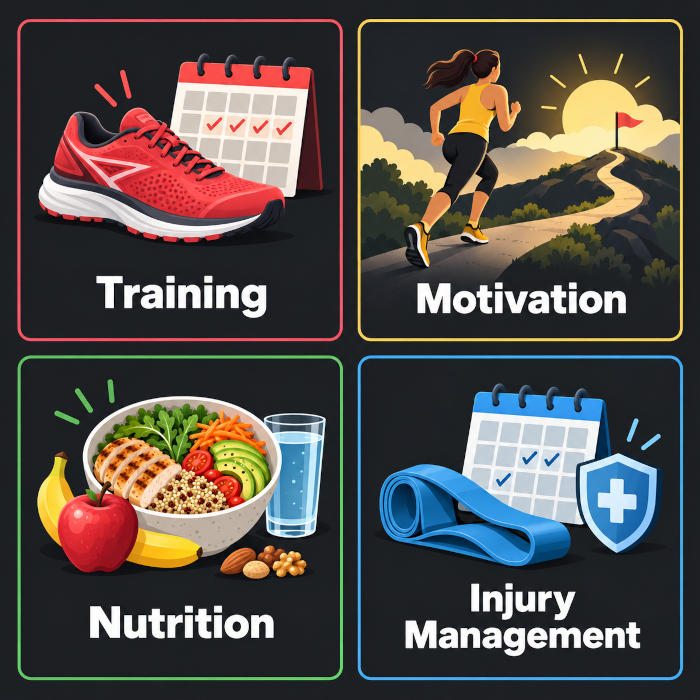
Motivation sits alongside Training, Nutrition and Injury Management as one of our Four Foundations. Each supports the others: training gives you a manageable path toward your goals, nutrition fuels your runs and recovery, and injury management guides you when your body needs a different approach. Motivation helps you get started, find satisfaction in your progress and keep going when enthusiasm fades.
This page brings together research, my running experience, and mental skills you can try yourself. I also share Julie’s and my experiences with brainwave entrainment—an experimental method we found interesting and often helpful—while distinguishing what we noticed from what research can support.
Build
running motivation and mental strength into your week
Think about what you want from running: better fitness, support with weight management, or the satisfaction of reaching a goal. Training for a parkrun or organised event can give your training direction and help you build running motivation and mental strength. Your goal might be to complete the distance comfortably, run more consistently or improve your time. Choose something that matters to you, then build towards it one run at a time.
Research suggests people are more likely to keep exercising when they enjoy it or value what it brings, like better fitness or a sense of achievement. Much of this evidence is observational, so it cannot prove cause and effect, but it supports finding reasons to run that matter to you personally. [1]
Following a running program gave me a clear goal and a way to see my progress. Whether it was eight weeks toward a 10k or eighteen weeks preparing for a marathon, each session I logged in my spreadsheet showed me moving closer to race day. I occasionally missed a run because of a niggle or everyday commitments, but seeing what I’d already completed helped me keep those interruptions in perspective and stay on schedule.
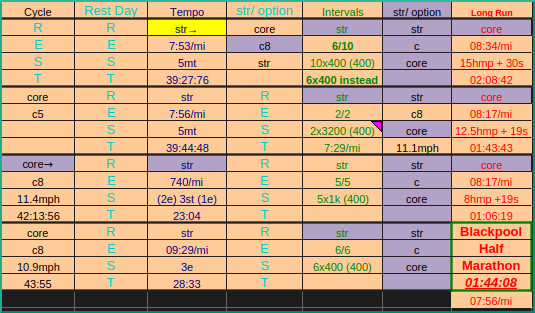
Running Tips HQ: Use rest days tactically! The purple squares in my Blackpool Half Marathon schedule (above) mark strength and core sessions I skipped to recover more as race day approached. I kept three weekly runs—tempo, intervals and long—and one cycling day, resting on the others.
Look at your usual week and decide when you can realistically run. Allow enough time for the session, plus time to get ready and shower afterwards. If you keep missing the same run because work or family commitments get in the way, move it to a more suitable day or time. Having a regular place for running in your week makes it easier to keep going and builds a rhythm.
A regular routine can support running motivation and mental strength by giving you a familiar time and place to begin. Studies found small improvements in how automatic exercise felt, although this does not show that participants maintained the habit over the long term. [2] Choose a routine that fits your life and is easy to repeat, while allowing for days when getting started still takes encouragement.
Choose running days that fit around your work and other commitments, allowing time to recover between sessions. If you need to move a run, check that it won’t leave demanding sessions too close together. Our running training plans can help you organise your week and work towards a goal.
Choose
goals that give your training purpose
Working towards a faster parkrun, 10k, or half marathon gave my training a clear purpose. Completing intervals I’d previously struggled with and finding my target tempo pace more manageable helped me build running motivation and mental strength. Those signs of progress gave me confidence and made me look forward to testing myself on race day.
Different goals do different jobs:
A goal gives you something to aim for, but it also helps to decide what you’ll do to work towards it. Sports psychologists distinguish three types:
| Goal type | What it means | Example |
|---|---|---|
| Outcome | Where you finish compared with others. | “I want to finish in the top ten in my age group.” |
| Performance | A result you want to achieve yourself. | “I want to improve my 10k time from 52 minutes to under 50.” |
| Process | An action you practice to help achieve that result. | “I’ll start at my planned pace, even if other runners rush ahead.” |
You don’t need a competitive placing to have a worthwhile goal. For most recreational runners, a personal target gives the training direction, while process goals help you decide what to focus on during each run.
A review of 27 studies across different sports found that process goals—focusing on actions you can control—yielded the greatest performance benefits, along with improved confidence. [3] For a runner, the practical lesson is to plan your training: if you want a faster 10k, practice starting at your intended pace rather than rushing off and struggling later. Keep the finishing time as your ambition, but focus during the run on the actions that help you achieve it. The review supports this approach to performance; it does not establish which goals keep runners motivated over the long term.
For running motivation and mental strength, connect your goal to what you can do in training. If you want to run a faster 10k, focus on completing appropriate sessions and recovering well between them. If you’re consistently struggling with the planned training, give yourself more time or adjust your target rather than forcing the pace to meet a race date.
My 2015 Blackpool Marathon diary shows why a goal sometimes needs to change. Training had become difficult, with recurring soreness and a bad cold interrupting the build-up. Eventually, I recorded that I was withdrawing because I hadn’t completed enough training. I still wanted the achievement, but I wasn’t adequately prepared for that race. Sometimes the sensible decision is to choose another opportunity rather than force yourself towards the original date.
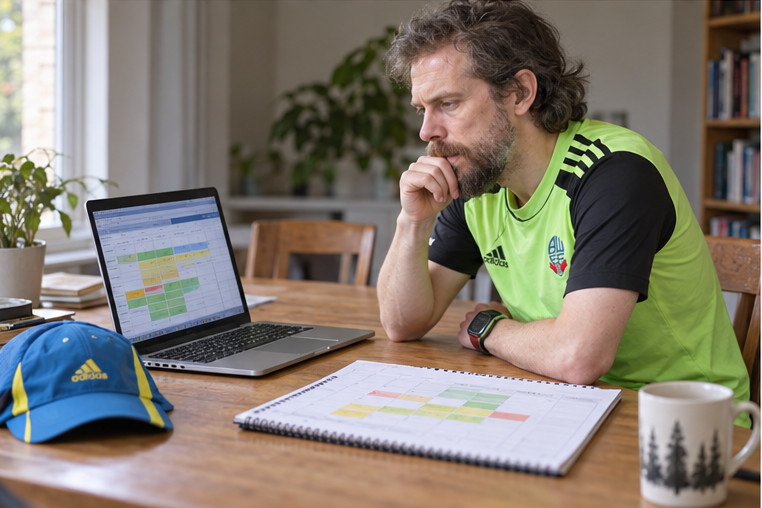
That experience reminds me to think about how a goal feels as its demands become real. Changing the distance, date or training commitment can be a thoughtful decision. A target should earn its place in your life.
Self-talk:
choose words that help you on a run
Self-talk is one way to work on running motivation and mental strength. A short, believable phrase can offer encouragement or remind you what to do when the effort increases.
Before a long run I expected to find difficult, I sometimes looked in the mirror and told myself, “You can do this”—firmly and with determination. Later, when I began to tire, I sometimes repeated those words aloud in time with my footfalls: “you—can—do—this.” It gave me something familiar to focus on when doubts crept in.
I found it helpful to have something familiar to return to when the effort increased. A few words were easier to remember than a motivational speech.
Choose a phrase that helps with what you need at that moment: “you can do this” for encouragement, “start steadily” to keep your early pace under control, or “relax your shoulders” to ease tension. You can say it silently or aloud, whenever it helps—it doesn’t need to match your stride.
Research offers some support, although results vary. In a small controlled cycling study, motivational self-talk reduced perceived effort and improved time to exhaustion. A trial involving 29 ultramarathon runners found no performance improvement, although many participants said they found the technique helpful and continued using it. [4, 5] Self-talk is therefore worth exploring as a practical skill, without expecting it to guarantee a faster finish.
Try one short phrase during an ordinary run. Notice whether it helps you settle, focus or respond to the effort. If it feels distracting or hard to believe, change the wording. An encouraging cue should also leave room to slow down or adjust your plans when you need to.
Affirmations:
rehearse a supportive message
Here, I use “running affirmations” to mean deliberate statements you repeat, often before running or as part of a regular mental-training session. They overlap with self-talk, but they focus on rehearsing a message rather than responding in the moment while running.
Examples include “athletic success comes easy to you” or “you always finish strong.” These phrases may feel encouraging, but consider what they mean to you and whether they help you approach training positively. If a statement feels too far removed from your experience, adapt it: “you’re building the fitness to finish strong” connects the ambition with the work you’re doing. The aim is to encourage yourself in a way you can believe, without expecting every run to go perfectly.

Julie and I have explored running motivation and mental strength through sessions combining brainwave entrainment with recorded affirmations. Based on our experience, we believe these sessions helped us feel more confident and motivated, and that the repeated affirmations influenced how we approached our runs and performed. But that is our personal interpretation, not proof of how the sessions work or what others should expect.
I would recommend giving it a trial and seeing what you think.
Mental imagery:
rehearse your response
Imagery means mentally rehearsing an experience before it happens. For runners, this might entail imagining the excitement of a race start, noticing the temptation to follow faster runners and choosing to settle into your own pace. The purpose is to make your intended response familiar, so it may be easier to use when the situation arises.
Suppose there’s a hill on your usual route that you find daunting. Before heading out, sit quietly and imagine yourself approaching it. Imagine shortening your stride, easing your pace and relaxing your shoulders. Hear your breathing and picture passing familiar landmarks—a gate, a bend, a tree—as you make your way up. Include the difficult part: imagine the effort increasing and yourself responding with the words, “You enjoy hill running.”
During the run, let the approaching hill remind you to put those rehearsed actions into practice. Imagery is one tool for developing running motivation and mental strength: it may help you feel better prepared and focus on how you’ll tackle the climb. Imagine the satisfaction of reaching the top, then link that feeling to practical steps like easing your pace and shortening your stride.
A large review found that imagery improved performance across a range of sporting tasks, although results varied by sport and study. This supports using it as a mental skill, but it doesn't show how much it will help an individual recreational runner. [6]

Choose one familiar situation, such as the start of a race or approaching a difficult hill, and spend a minute or two mentally rehearsing how you want to respond. You do not need to picture every detail clearly. Imagine where you are, what your body is doing and the specific action you will take—for example, relaxing your shoulders, shortening your stride or reminding yourself to start steadily.
Build
running motivation and mental strength when confidence dips
Self-doubt, a missed workout or a disappointing race can shake your confidence. Start by asking what needs attention. Are you questioning your ability, struggling to fit training into your week or disappointed with a result? Each calls for a different response: recognising your progress, adjusting your routine or learning from what happened.
My confidence grew as I saw my training pay off. An interval session that went better than the previous one, or a target pace that felt more manageable, gave me something concrete to remember when doubts returned.
Progress might mean completing a run-walk session comfortably, returning after a break or keeping an easy run at a comfortable effort. Recording how you felt and what you enjoyed, alongside distance and pace, can support your running motivation and mental strength by making those improvements easier to recognise. Finishing with more energy, pacing yourself better or running more consistently all count—even when your times stay the same.
Research links self-efficacy—belief in your ability to manage a particular task—with exercise participation and responses to lapses. These associations don't prove that confidence determines whether you keep running, but they show why small, achievable successes matter. [7, 8] When doubt returns, those successes give you specific examples of what you have already managed and something to build on.
Missed
workouts: make the next decision manageable
One missed session tells you very little about your future as a runner. It does give you a chance to ask why the plan didn’t fit that day.
Was the time slot unrealistic? Did an unexpected commitment intervene? Were you unusually tired? The answer matters because reorganising the diary and allowing more recovery solve different problems.

My practical approach is to look ahead before moving a missed run. If rescheduling crowds demanding sessions together, letting it go may be the better choice. After a longer interruption, reconsider the point in the program you can comfortably resume. This is a planning judgement, not a rule established by a single motivation study.
Bigger
setbacks: learn from what happened and rethink the next goal
A disappointing race or several weeks of disrupted training may need more reflection than a single missed run. Give yourself time to feel disappointed, then consider what affected the outcome: your preparation, pacing, conditions, recovery, or circumstances beyond your control. Was the goal realistic for the time and energy you had available?
An honest review doesn't need to become an exercise in self-blame. In a small trial involving self-critical women athletes, a self-compassion intervention reduced self-criticism, repetitive negative thinking, and worry about mistakes. The findings don't tell us how every runner should handle a setback, but they suggest that treating yourself more kindly can reduce an overly harsh response. [9]
Building running motivation and mental strength after a setback starts with choosing one lesson you can use—perhaps starting more steadily or allowing more recovery between demanding sessions. Set your next goal around what you can manage now, giving yourself time to rebuild rather than feeling you must make up for a disappointing result. If injury or illness interrupted your training, let your recovery and any individual advice guide your return.
Give
long runs smaller stages
Many of my longer runs followed canals. Returning along the same route gave me an incentive to go a little farther as the program advanced: I wanted to see what existed beyond where I had been last time. Curiosity became part of the reward.

I also divided long runs into three-mile stages. Those were checkpoints to drink from my Osprey bladder while moving and check my pace; I sometimes took a gel there too. The distance felt more manageable when I had a nearer marker to reach.
That was my routine, rather than a fuelling prescription. Drinking and carbohydrate needs depend on the outing and the individual; a three-mile mental checkpoint needn’t dictate when you drink or eat.
Break the run into manageable sections using familiar landmarks, parts of a loop or planned walk breaks. Give each section a simple focus: start gently, find a relaxed rhythm, then check how you feel at the next marker. Use these points to decide whether to continue as planned, slow down or take a walk break—not as targets you must reach regardless of how you feel.
Make
room for running in bad weather
Some of my best runs began with a low mood and very little desire to leave the house, especially when it was raining. Often, after about half a mile, my body started responding, and I began to enjoy myself. I seldom regretted going.
Remembering that became a strong incentive on another reluctant day. Over time, I even came to enjoy conditions I once resisted, including snowy long runs around New Year.
That is my experience, rather than a promise that every reluctant start will improve. I distinguish ordinary reluctance from being unwell, injured or unusually exhausted. Conditions also matter: enjoying challenging weather does not make an icy route or poor visibility a sensible choice.

Prepare for likely conditions, choose a suitable route, and permit yourself to change the outing. A shorter sheltered loop, another time of day or a different activity may preserve the purpose of the session better than insisting on the original plan.
Exploring
brainwave entrainment and subconscious processes
My interest in running motivation and mental strength also includes methods with less settled evidence. Years ago, Julie and I used brainwave entrainment software alongside recorded affirmations, relaxation and visualisation. I remember feeling more focused and motivated, and some training-diary entries from the time record those impressions.
Brainwave entrainment uses rhythmic stimulation to influence brain activity. It includes different methods, which should not be treated as interchangeable. For example, a systematic review of binaural beats found inconsistent evidence for reliable EEG entrainment; it did not establish running-performance benefits. [10]
The affirmations in the “zone” sessions seemed particularly helpful to me. One phrase—“You easily go into the zone”—played alongside three other affirmations, and I felt my running performance improved. Coincidence? Or were those repeated words coming back to me during runs, influencing my confidence, focus or expectations?

I cannot separate the effects of the affirmations from the stimulation, relaxation, regular practice or changes in my training. Our experiences give me reasons to investigate further, rather than proof of what worked. I’m particularly interested in whether repeated phrases can become familiar cues we draw on with less deliberate effort—a process often associated with the subconscious.
I'll share the detailed page after further research and renewed personal exploration. I’ll examine the claims alongside our observations, including alternative explanations, without presenting the sessions as proven methods for healing injuries or improving performance.
Choose
something useful for your next run
You don’t need to adopt every technique here. If getting started is difficult, look at your routine and what makes running worth doing. If a goal excites you, connect it with manageable training. If a long outing feels too challenging, try a familiar cue or divide it into smaller stages.
Developing running motivation and mental strength is an ongoing part of learning how you run best. Keep the Four Foundations connected: Motivation gives direction, Training builds capacity, Nutrition supports the work, and Injury Management helps you respond to problems and adjust your plans.
Choose one idea to try, notice what happens and build from there. My spreadsheet helped me see a whole marathon program taking shape. On other days, all I needed was a familiar stretch of canal and four words: “You can do this.”
See you out there,
Andrew
Running Injuries Hub
Learn what commonly causes running injuries, when pain is a warning sign, and how to return to running without rushing the process.
👉 Explore the Running Injuries Hub here
References Used:
- Teixeira et al.(2012). Exercise, physical activity, and self-determination theory: a systematic review. Broad exercise evidence; much of it observational.
- Effects of habit formation interventions on physical activity habit strength: meta-analysis and meta-regression (2023). Ten studies; the principal outcome was self-reported habit strength.
- The performance and psychological effects of goal setting in sport: a systematic review and meta-analysis (published online 2022). Twenty-seven studies across sports; performance findings should not be equated with long-term adherence.
- Blanchfield et al.(2014). Talking yourself out of exhaustion: the effects of self-talk on endurance performance. Small controlled cycling study.
- McCormick, Meijen and Marcora (2018). Effects of a motivational self-talk intervention for endurance athletes completing an ultramarathon. Small running trial with no demonstrated performance benefit.
- The Effects of Imagery Practice on Athletes’ Performance: A Multilevel Meta-Analysis with Systematic Review (2025). Broad sporting evidence; not a runner-specific prescription.
- Predictors of lapse and relapse in physical activity and dietary behaviour: a systematic search and review on prospective studies (online 2021; journal issue 2023). Associations with self-efficacy; limited evidence for many other predictors.
- Pereira et al.(2021). Systematic Review of Psychological and Behavioral Correlates of Recreational Running. Runner-specific review with uneven study quality.
- Mosewich et al.(2013). Applying self-compassion in sport: an intervention with women athletes. Small trial focused on self-critical varsity women athletes.
- Ingendoh, Posny and Heine (2023). Binaural beats to entrain the brain?. Review of EEG outcomes; does not establish running benefits.
To return from Running Motivation and Mental Strength back to the Home Page, click here >>>
Recent Articles


-
Running Motivation and Mental Strength: Find Your Focus
Oct 16, 26 07:28 AM
 Build running motivation and mental strength with practical habits, goals, self-talk and ways to handle setbacks, informed by research and running experience.
 -
Running for Beginners: Start Small, Build a Lasting Habit
Oct 06, 26 05:11 PM
 Explore running for beginners with practical run-walk advice, clear guidance and first-hand experience. Start at your own pace and build a lasting habit.
 -
Running Training Plans | From Beginner to Advanced
Oct 04, 26 05:00 PM
 Find running training plans for your first target, a faster 5k or 10k, or a half or full marathon—with advice to balance training, recovery and everyday life.
