- Home
- Running Training Plans
Running
training plans: build towards your next goal
By Andrew Greehalgh September 2026
The most useful running training plans begin with what you can manage today. Whether you’re starting from scratch, returning after a break or ready for a new challenge, you’ll find guidance here to choose your program, build on your fitness and give your running something to aim for.
Explore the running training plans below, and check back as I add more. Further down, I explain what to look for in a schedule and how years of following and designing my own plans have shaped my training. If speed work is new to you, a sub-25-minute parkrun or sub-50-minute 10K could breathe new life into your running. Or perhaps the challenge of a half-marathon, marathon or beyond appeals more…

Choose
from our running training plans
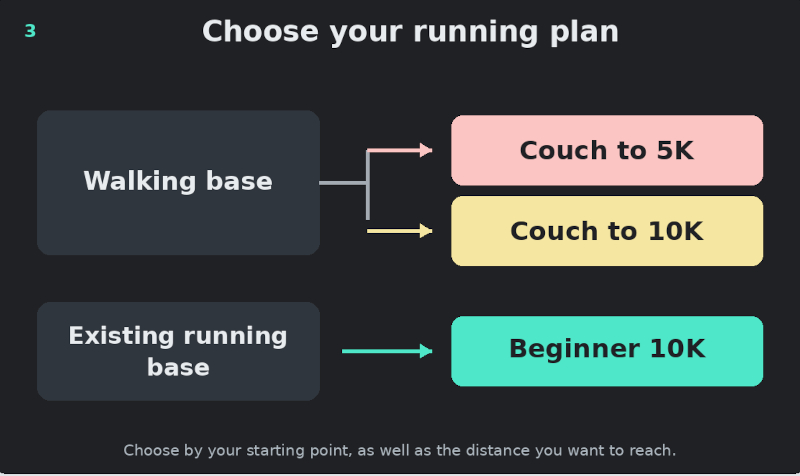
The three programs below each involve three runs a week, while future plans may include four or five. Choose according to your starting point: the couch plans introduce running through a mix of walking and running, while the beginner 10K plan starts with an existing running base. The entry guidelines describe what you should comfortably manage before starting each plan; they are not medical fitness tests.
Which published program fits your starting point?
| Your starting point | Available plan | What to expect |
|---|---|---|
| New to running; comfortable walking for about 30 minutes. | Couch to 5K | Short run–walk intervals, repeatable stages and time to build towards the full 5K. |
| New or returning runner; comfortable walking for about an hour. | Couch to 10K | A run–walk route towards 10K, with a flexible 12-week outline that can take longer. |
| Already running about two miles comfortably. | Beginner 10K plan | An eight-week outline building from an existing running base towards 10K. |
If the first session of a couch plan already looks demanding, walk more or start with fewer, shorter running intervals. Choosing a smaller first step can make it easier to build a routine you want to repeat.
The distinction between the two 10K routes matters. Couch to 10K is for building into running; Beginner 10K is for building on running you can already do. You don’t have to complete Couch to 5K first if the Couch to 10K starting point suits you. Equally, 5K can be a satisfying destination in its own right.
Running
training plans: find a starting point that fits your life
When comparing running training plans, check the opening week and ask yourself three questions: can I manage these sessions at the intended effort, can I fit them into my week, and will I have enough time to recover between them? Look further ahead too: a schedule that fits comfortably now may need more time in your diary as the runs get longer.
When I returned to running in 2006, I had to start with the fitness I had, rather than the fitness I remembered. Short run–walk intervals gave me a manageable way back. Knowing I’d run before didn’t make me any less out of breath.
When returning after a break, base your starting point on what you can comfortably manage now. An old race time is a reminder of what you once achieved, but your current fitness should guide the distance and pace of your first sessions back. If you are returning from an unresolved injury, get individual advice before treating a general schedule as your comeback plan.
By the way, if you are returning from an unresolved injury, get individual advice before treating a general schedule as your comeback plan.
Leave some flexibility around an event date. Repeating a stage may be exactly what you need, and a calendar entry shouldn't force the next increase. Of course, you can also choose a personal route and complete your distance when you feel ready.
How to adapt running training plans
Running training plans give direction, but they cannot account for every poor night’s sleep, demanding shift or family interruption. My practical approach is to review how a run feels before adding more. Could you complete it without forcing the pace, and did you recover well enough for the next outing?
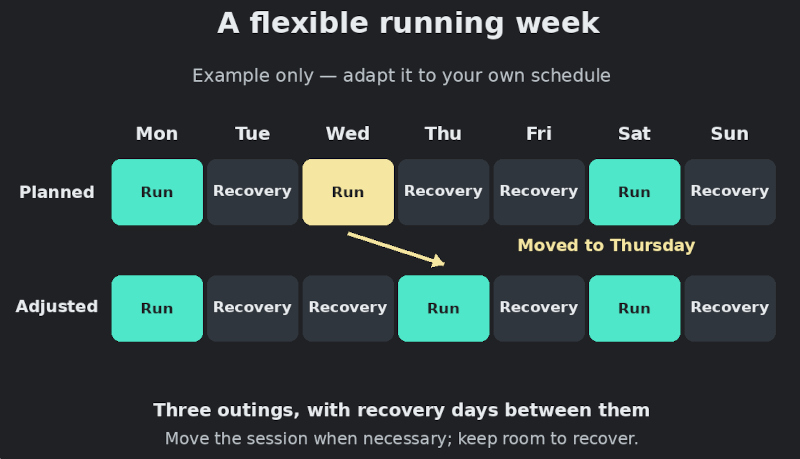
After one missed session: if you can move the run to another day and keep the recovery time your plan calls for, do so. Otherwise, skip it and continue with your next scheduled session, as long as it feels manageable. Don't double up or squeeze runs together to make up for the missed outing.
When a stage is too demanding: repeat it, shorten the running intervals or reduce the number of repeats. Repeating a week is also an option in the NHS beginner program. [1]
After a longer gap: restart with less running than you were doing before the break, then see how you respond. How much to reduce depends on how long you’ve been away, why you stopped and what feels manageable now. No established formula tells you exactly where to restart for each day missed.
Be cautious about relying on a fixed rule as you build back up. The familiar “10% rule” suggests increasing your total weekly running distance by no more than 10%. Yet a trial in novice runners found no fewer injuries with a longer program following that rule than with a shorter program. This doesn’t mean gradual progression is pointless; it means the rule doesn't guarantee protection against injury.
A later observational study looked at individual runs instead of weekly totals. Runners who covered substantially more distance than their longest run in the previous 30 days had higher injury rates. The study cannot prove that those increases caused the injuries, but it raises a useful point: even a modest weekly total can contain one outing that is a large jump from what you’re used to. Consider both how much you run across the week and how far you extend any single run. [2, 3]
My practical advice when following running training plans is to give yourself more time at a difficult stage and avoid increasing distance, pace and frequency all at once. Notice how you recover before taking the next step. If you develop persistent or worsening pain, pause and seek appropriate advice; moving to the next week of a schedule is no reason to keep pushing through it.
Understand
what each session is doing
The names can sound more complicated than they need to be. A beginner run–walk plan mainly develops the habit and your ability to keep going. Performance plans may add faster sessions, but the plan should explain their purpose and effort clearly.
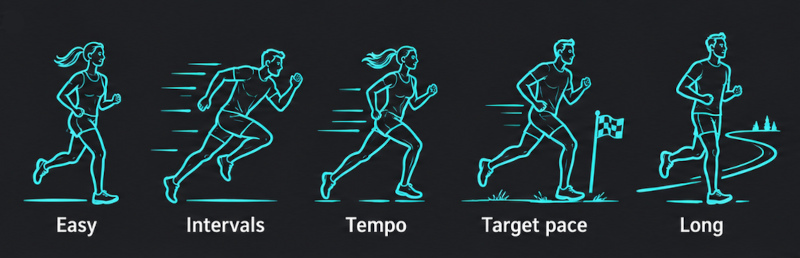
A short guide to common session labels
| Session | What it means in practice |
|---|---|
| Easy run or run–walk | A comfortable, controlled outing. Walking breaks can help you manage the effort. |
| Intervals | Repeated running efforts with recovery between them. The duration, pace and recovery determine the demand; intervals do not automatically mean sprinting. |
| Tempo / threshold | A sustained, purposeful effort, or longer repetitions. Coaches use “tempo” differently, so read the plan’s pace or effort instructions. |
| Target-pace runs | Practising the pace you’re aiming to maintain over your chosen race distance, for a specified time or distance in training. A marathon target pace and a 5K target pace involve very different efforts. |
| Long run | The longest run in your week, with distance and pace suited to your current fitness and training goal. What counts as “long” will change as your running develops. |
When comparing running training plans, consider how they balance easy running with harder sessions. In an eight-week study of recreational runners, researchers compared a program built mainly around easier running with one that devoted more training to moderate efforts. Both groups improved similarly, although the second program required less training time. This small study doesn’t establish which approach is best, but it shows why I wouldn’t judge a schedule solely by mileage or the number of hard sessions. The balance matters—and your chosen plan needs to fit the time and recovery you can give it. [4]
What
FIRST taught me — and why I adapted it
I followed the FIRST approach from Run Less, Run Faster for two marathons, two half-marathons and several 10Ks over several years. Its structure centres on three purposeful runs — intervals, tempo and a long run — alongside aerobic cross-training. [5]
I used the cross-training advice too: usually cycling twice a week, sometimes once, and fitting in multigym strength—also twice a week. In my mind, strength training counted as cross-training as well. I now find it clearer to distinguish its role from the aerobic work I was doing on the bike.
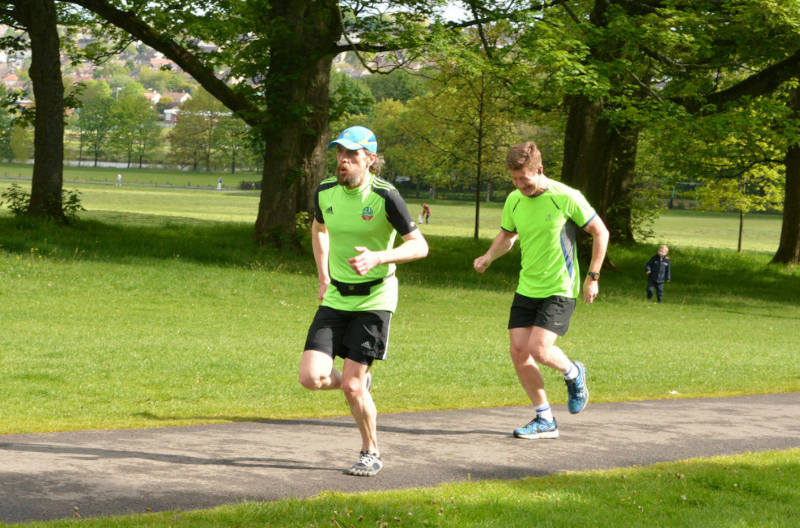
Speed training completely reinvigorated my running. After completing a distance, having a time to aim for made familiar routes interesting again. Designing a schedule around that goal gave each session a purpose.
As I moved into my fifties—I’m 58 as I write this—I found that fewer speed sessions suited me better. Instead of doing both intervals and tempo each week, as FIRST prescribed, I alternated them from week to week and used the freed-up session for an easy run. I also found FIRST’s tempo efforts demanding, so I preferred a slower pace that matched my target for the event I was training towards. Over time, these adjustments became my Easy–Fast–Long approach, shaped by years of training and learning what worked for me.
How I arranged Easy–Fast–Long — a personal example
| Run | One week | The following week |
|---|---|---|
| Easy | Easy run | Easy run |
| Fast | Intervals | Target-pace run — my adapted tempo session |
| Long | Long run | Long run |
I fitted cycling and strength work around those runs. Long-run pace varied with the event and my fitness: when working towards a faster 10K, I used slower long runs, sometimes up to 12 miles. In some half-marathon and marathon preparations, I extended running at target pace as my fitness developed. That could be demanding work too; fewer speed sessions did not make every other run easy.
This is an account of what worked for me, rather than a tested prescription for all older runners. I want to develop it properly for runners who want a less frequent dose of speed work, including those over 50. The detailed pace choices and progressions deserve their own guide.
Support
your plan with the Four Foundations
Physical Strength. Running develops your ability to meet the demands of the next outing; strength work adds a different stimulus. A 2024 review found that some strength-training methods improved running economy — the energy cost of running at a given speed — although certainty was low to moderate. That supports including suitable strength work, without promising that it makes anyone injury-proof. [6]
Cycling can contribute aerobic work without adding another running session, while strength work focuses more directly on muscular force and capacity. FIRST itself includes aerobic cross-training as part of the program. [5] Neither belongs in your diary to fill every spare day: introduce extra work in amounts you can recover from.
Mental Training. Set a goal that means something to you, break it into manageable stages, and recognise progress beyond pace. A calmer run or a consistent week can boost your confidence in its own right. You’ll also find running affirmations on this site, and I’m developing a brain entrainment and cognitive training program to explore focus and mental stamina to combat fatigue. I’m looking forward to sharing its development, the research behind it and ways to try it for yourself.
Nutrition. Eat enough to support the training, with varied meals that include carbohydrate foods, protein sources, fruit and vegetables, and fats. General healthy-eating guidance provides a starting point; longer events need more specific fuelling practice. [7] Detailed nutrition belongs alongside the relevant plan, rather than being squeezed into one rule for every distance.
Running Knowledge. Understanding the research behind training decisions helps you set realistic running targets, judge your training load and recognise when to progress or ease back. It also helps you see why a session belongs in your plan and what it is meant to achieve. I examine the evidence behind familiar advice and draw on years of running to make it useful in practice, explaining both what the research supports and where questions remain.

Take
the next step
For now, choose Couch to 5K for a gradual introduction, Couch to 10K if the longer goal appeals and the starting point fits, or the Beginner 10K plan if you already have a comfortable two-mile running base.
Already running 10K and ready for a new challenge? I’m developing faster 10K programs, drawing on earlier drafts and my experience training toward a target time or personal best (PB). Half-marathon and marathon plans are on my longer-term list too. I’ll add links here as each program becomes available over the coming months.
You can keep using walking breaks, choose a local event, or measure a route of your own. A comfortable routine that fits your life is worth building, whether or not you enter a race.
For me, having a goal keeps the juices flowing. A quicker 10K, a first half-marathon—or perhaps the M-word has already crossed your mind?
Yes, marathon.
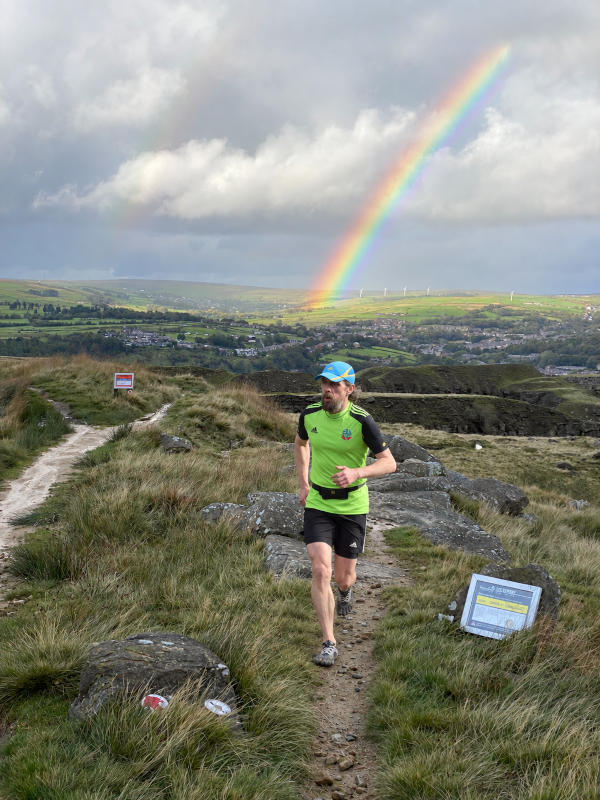
No need to commit just yet, but if you’ve ever thought “maybe one day”, I know how that starts. For me, a 10K became a 10-miler, then a half-marathon, until there I was at a marathon start line, gels strapped around my waist like ammunition, wondering what I’d let myself in for.
Whatever appeals to you, a goal gives your weekly runs a purpose, and a plan gives you a way to work towards it.
Choose from the running training plans above, read the program’s opening guidance and put the first few outings in your diary. Leave room to adjust as you discover what works for you. The next challenge simply needs to give you something to look forward to—and that “one day” might eventually find its way into your diary.
— Andrew
Research
used:
[1] NHS — Couch to 5K running plan Practical guidance on run/walk sessions, recovery days and repeating stages; not validation of the My Running Tips schedules.
[2] Buist I and colleagues (2008). No effect of a graded training program on the number of running-related injuries in novice runners: a randomized controlled trial. Compared a 13-week program using the 10% rule with an eight-week program; it did not establish an injury-prevention advantage.
[3] Frandsen JSB and colleagues (2025). How much running is too much? Identifying high-risk running sessions in a 5200-person cohort study. Observational evidence on single-session distance increases; association does not establish causation or a universally safe threshold.
[4] Festa L and colleagues (2020). Effects of Different Training Intensity Distribution in Recreational Runners. Eight-week comparison in recreational runners. Useful for questioning universal intensity formulas, not for validating Easy–Fast–Long.
[5] Furman University — FIRST: Services and Training Programs Primary description of FIRST, its running sessions, prescribed paces and aerobic cross-training. A description of the method is not proof of superiority.
[6] Llanos-Lagos C and colleagues (2024). Effect of Strength Training Programs in Middle- and Long-Distance Runners’ Economy at Different Running Speeds: A Systematic Review with Meta-analysis. Strength training and running economy; certainty was low to moderate, and results varied by training method and running speed.
[7] NHS — The Eatwell Guide General varied-diet guidance, rather than a race-fuelling prescription.
Recent Articles


-
Running Training Plans | From First Steps to Faster Times
Sep 30, 26 04:27 PM
 Find running training plans for your first 5K, a faster 10K or next distance goal, with guidance on starting points, recovery and fitting runs into your life.
 -
Couch to 10K for New and Returning Runners | My Running Tips
Sep 29, 26 11:10 AM
 Couch to 10K helps you prepare for event day, handle setbacks and judge when you’re ready for the full distance. Includes a printable schedule.
 -
Couch to 5K Plan | Start Running at Your Own Pace
Sep 24, 26 05:03 PM
 Start Couch to 5K with a flexible run/walk plan for your first parkrun or a return to running. Repeat stages and build towards the full 5K at your pace.
