Compare walking
versus running for fat loss By Andrew J. Greenhalgh - Updated September 2026
Walking versus running for fat loss might seem an easy contest: running usually burns more calories per minute, so surely it wins? That advantage matters, but so does what happens beyond the session—how hungry you feel, how well you recover and how much activity you can enjoy and sustain week after week.[1]
If you are beginning exercise or returning after a break, this guide will help you choose between walking, running and combining both. We’ll look at what the research can tell us, where it leaves questions unanswered, and how ordinary things such as hunger, hip trouble and a busy week can influence the decision.
Calories
burned: compare equal time, equal distance and weekly totals
Running usually burns more calories than walking for the same amount of time. But does walking a mile burn as many calories as running a mile? Not necessarily—the distance alone doesn’t determine how much energy you use.
In a study of 24 people, researchers measured energy expenditure while participants walked and ran 1,600 metres. The treadmill averages were about 115 kcal for running and 81 kcal for walking, converted from the published kilojoule figures. Running was performed at twice the walking speed. [1]
Those are study averages at particular speeds, not figures to copy into your own food allowance. Body size, pace, gradient and terrain affect the comparison. The practical finding is that running can use more energy over the same distance as well as getting you there sooner.
These figures are study averages, not a prediction of your own calorie burn. Your weight, pace and the terrain will affect how much energy you use. The useful finding is that running burned more calories than walking over the same distance under the conditions tested—and took less time. That gives running an advantage when time is limited, although a longer walk may suit your fitness and preferences better.
| Consider… | Walking | Running |
|---|---|---|
| Time available | Can fit into errands, lunch breaks or longer outings. | Usually uses more energy in a shorter session. |
| Starting point | Often the more accessible starting option, with pace and terrain adjusted to suit your fitness. | Requires enough fitness to run regularly without excessive fatigue or problems recovering. |
| Hunger afterwards | Can increase hunger, especially on longer outings. | Appetite varies. Running may briefly reduce hunger, but many runners still eat soon afterwards. [5][6] |
| Recovery | Usually easier to recover from, although long or hilly walks can still be tiring. | Recovery depends on the length and pace of the run, as well as your current fitness. |
| Enjoyment | Well suited to socialising, exploring and enjoying time outdoors. | May suit people who enjoy the rhythm, effort and feeling afterwards. |
Then consider the week you could actually complete. A longer walk may contribute more total activity than a short run; several manageable runs may suit someone with limited free time. Neither comparison works unless you include duration, frequency and what happens afterwards.
Burning
fat during exercise is not the same as losing body fat
Walking often gets a larger share of its energy from fat than running does, but running usually burns more calories per minute. The percentage supplied by fat during either activity does not tell you how much body fat you will lose over the following weeks. [7]
Diet changes this fuel mix too. Keto-adapted endurance athletes can use substantially more fat during exercise, and some small athlete studies have reported improved body composition on ketogenic diets. However, they do not establish that fat adaptation itself causes greater fat loss independently of food intake and training. Some of the fat burned also comes from food. [12–14]
For walking versus running, the practical point is that food intake and total energy expenditure over time influence whether stored body fat decreases. Walking in a “fat-burning zone” does not guarantee fat loss, and burning more carbohydrate while running does not prevent it. [7][10]
Research comparing high-intensity intervals with continuous aerobic exercise has produced mixed findings: some reviews report similar fat loss when energy expenditure is matched; others find advantages for intervals on certain measures. These comparisons do not directly settle ordinary walking versus easy running. Choose an activity—or combination—you enjoy, recover from and can maintain, rather than judging it by its “fat-burning” label. [2][3]
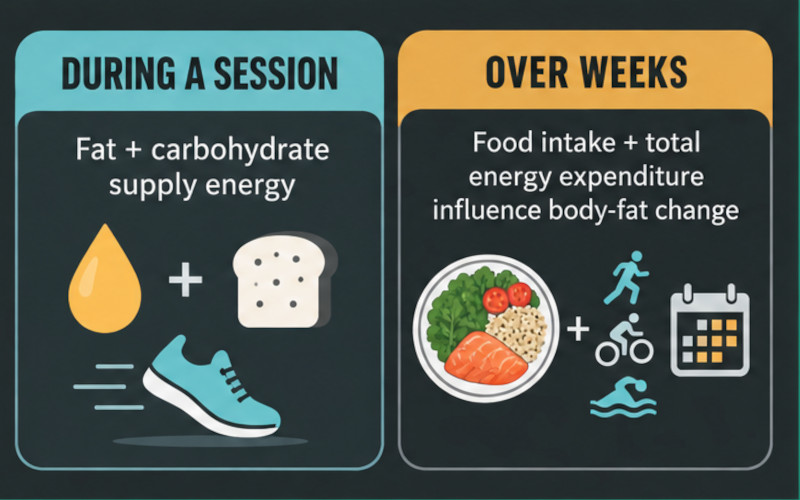
The fuel you use today does not, by itself, predict the body fat you lose.
Hunger
and tiredness: what happens after the workout?
Running certainly makes me hungry. I generally have my evening meal after a run, and later in the evening I often feel both tired and ready for more food. Ordinary dog walking does not affect me in quite the same way; I’m more likely to notice hunger after a walk lasting over an hour.
I usually have a homemade drink after running: whey protein, semi-skimmed milk, Greek yogurt, cocoa powder and honey. I find it helps with night-time hunger and use it as part of meeting my maintenance needs. That is my routine, rather than a fat-loss recipe. It contributes energy like anything else I eat or drink. The extra 25g of protein helps me reach my daily target of protein (good for recovering muscles).
Feeling hungry after running does not mean you will replace all the calories you burned. In a small study involving nine female runners and ten female walkers, runners did not fully replace the energy used during their run through eating afterwards. However, the study compared separate groups, each also tested at rest; it did not test walking and running in the same people. It therefore tells us little about how hungry an individual beginner might feel later that evening. [5]
A wider review suggests that aerobic exercise can temporarily reduce hunger, although responses vary. You may feel little appetite straight after a run, then become hungry later.[6]
There is another possible adjustment: moving less during the rest of the day. If a demanding workout leaves someone unusually inactive afterwards, some of its extra expenditure may be offset. Increased food intake can also narrow the expected deficit. Neither response is inevitable, and neither proves walking is better. [10]
For your own comparison, notice when hunger arrives, whether meals satisfy you, and how you feel the following day. Persistent exhaustion or hunger is a reason to review the balance of food and activity. It is not an instruction to ignore your body because you are trying to lose fat.

When
walking is a good choice
Walking makes sense when it is an activity you enjoy, can fit into your day and can currently manage comfortably. You do not have to graduate to running for your activity to count. Walking can be part of the regular aerobic activity recommended for health. [8]
I rarely choose walking alone when comparing walking versus running for fat loss because it does not give me the cardiovascular workout I’m looking for. I enjoy the stronger effort and the feeling I get after a run.
That reflects my own preference and fitness level, though. For someone starting from a different point, a brisk walk may provide a substantial cardiovascular workout and be exactly the right place to begin.
Julie now mainly walks and hikes because of her hip issues. She has recently begun adding very short running intervals, but walking remains the basis of much of her activity. That gives us different starting points even within the same household.
Walking also has a practical advantage when it fits naturally into something you would do anyway: getting somewhere, taking the dog out or spending time with someone. I don’t count my normal dog walks as workouts, but they still form part of my daily movement.
The limitation is time. If you want to match the energy used in a particular run, you may need a longer walk. Longer or hillier outings can also be tiring; “walking” covers much more than a gentle stroll. Choose the duration and terrain you can manage rather than assuming every walk is a recovery session.
When Walking Versus Running for Fat Loss — or a Combination — Suits You Better
Running is a reasonable choice when time is limited, you enjoy it and your current fitness allows you to repeat it comfortably. There is no need to turn every outing into a hard session to justify choosing it.
Nor should we assume that everyone sticks with easier exercise more successfully. A large review found no clear difference in attendance between supervised high-intensity intervals and moderate continuous training. Findings outside supervision were much less certain. These were not direct walking-versus-running comparisons, but they challenge the idea that lower intensity automatically means better adherence. [4]
For me, run/walk is especially useful when returning from injury. While rebuilding after greater trochanteric pain syndrome—pain around the outside of the hip—I often run for three minutes and walk for one, covering around 2–3 miles twice a week. I enjoy this as much as continuous running, although once my hip and fitness allow it, I like settling back into an uninterrupted run.
Run/walk has also helped me explore much further afield. I used to head through Lee Quarry and out into the Rossendale hills, covering ten, eleven, sometimes twelve miles or more on steep routes. Running for fifteen minutes, then walking for three, made those outings possible. I couldn’t have covered the same routes running continuously.
The walking breaks allowed me to spend longer exploring and cover more ground than I could otherwise have managed. I felt these longer outings helped when I wanted to lose weight: I was doing more activity, but how much weight I lost also depended on how much I ate afterwards.
For me, this was another use for walking breaks: a way to make a longer adventure possible. My current shorter outings are about rebuilding, but the same broad approach once helped me reach places I would otherwise have missed.
Julie’s current approach uses fifty seconds of walking followed by ten seconds of running. She enjoys making her walks more challenging and, after a thirty-minute session, notices more hunger and tiredness than after walking alone. What matters to her is that she is still running, even if it is only ten seconds in each minute.
Our current routines are mainly about fitness and enjoyment. I also notice that I tend to gain a little weight when regular exercise drops away, but we have not measured fat loss from our present run/walk routines. They illustrate ways of staying involved in activity, not proof that one interval ratio produces better fat loss.

Combining both can mean alternating within one session or taking walks on days between runs. Direct evidence that a mixed approach produces more fat loss than walking or running alone is limited. Its value here is practical flexibility, not a proven metabolic advantage.
For beginners, alternating walking and running is also an established way into running: the NHS Couch to 5K programme uses this approach, with rest days between sessions. [9] Our own ratios describe where we are now; they are not targets for everybody or rehabilitation instructions for another person’s hip.
If you would like a structured starting point, see my Couch to 5K plan. Choose a starting level you can manage, and let recovery guide whether you progress or repeat. If an injury is limiting you, use an individual return-to-running plan with your clinician or physio.
Make
your choice, then review how it is working
Start with your current fitness and the time you genuinely have. You can change your approach as your fitness, health or preferences change; choosing walking or running is not a lifelong commitment.
Choose walking if it is currently comfortable, enjoyable and realistic. Choose running if you already tolerate it and want to use shorter sessions effectively. Choose a mixture if you like running but prefer breaks, or want walking to contribute alongside your runs.
For general health, WHO recommends 150–300 minutes of moderate aerobic activity or 75–150 minutes of vigorous activity weekly, or an equivalent combination, plus muscle-strengthening activity on at least two days. These are health recommendations, not a guaranteed fat-loss dose or a first-week requirement. [8]
For someone already able to manage it, five thirty-minute brisk walks illustrate the lower moderate-activity target. A mixture could be three thirty-minute brisk walks and two fifteen-minute vigorous runs. That equivalence concerns health guidance; it does not mean identical calories or fat loss. In run/walk sessions, the effort and time in each part matter.
Build from what you can do now. Weight loss and prevention of regain may require more activity than the basic health target, and food intake remains part of the equation. There is no single weekly number that guarantees either outcome. [10]
Review progress over several weeks when comparing walking versus running for fat loss: the sessions you completed, hunger, recovery, and weight or waist trends if fat loss is your goal. If progress stalls, consider the whole pattern before adding harder exercise. Keep fitness gains and enjoyment in view as worthwhile outcomes too.
Strength work can support the wider goal: a review found that resistance training helped reduce lean-tissue loss during weight loss. [2] My strength training for weight-loss runners guide explains how to fit a manageable routine alongside running.
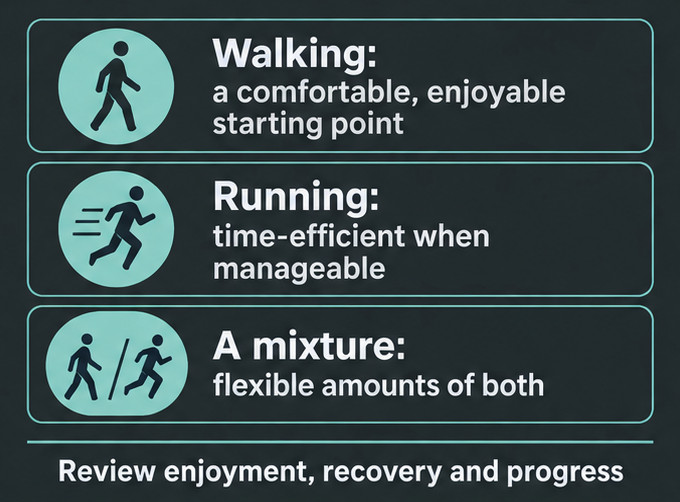
Choose for your current circumstances, then adjust as they change.
This is where the 3 foundations become a useful focus. Physical strength helps you build the capacity to train and recover, mental strength helps you maintain patience, confidence and motivation when progress is uneven, and knowledge helps you understand what your training is doing and when to adapt it.
Together, they encourage better decisions rather than simply harder ones. The aim is to build a running routine that is effective, sustainable and capable of earning its place in your life.
Your Next Step
Choose a manageable approach for the coming week: walking, running or a mixture of both. Pay attention to how well it fits your available time, enjoyment and recovery, then adjust it as your fitness develops. For the wider picture of food, exercise and sustainable progress, read my running to lose weight guide .
A few common questions
Can I lose body fat by walking alone?
Walking can be your main form of aerobic exercise and help you lose fat when your overall activity and food intake create an energy deficit. Running can increase the amount of energy you use when your fitness allows, while strength training helps maintain muscle and provides additional health benefits. [2][10]
Is thirty minutes of running better than thirty minutes of walking?
Running usually uses more energy in that time. That makes it more time-efficient, but not automatically a better choice if you cannot currently tolerate or repeat it. Compare the sessions you can realistically sustain. [1]
Do I have to stop taking walking breaks eventually?
No. Continuous running can be a goal if you want it, but you can also keep a mixed routine. I use walking breaks while rebuilding; Julie enjoys the short running intervals within her walks. Neither of us needs an uninterrupted run for the session to feel worthwhile.
Reference Sources
[1] Hall et al. (2004). Energy expenditure of walking and running: comparison with prediction equations. Medicine & Science in Sports & Exercise, 36, 2128–2134. Read source
[2] Bellicha et al. (2021). Effect of exercise training on weight loss, body composition changes, and weight maintenance in adults with overweight or obesity. Obesity Reviews, 22, e13256. Read source
[3] Effect of High-Intensity Interval Training vs. Moderate-Intensity Continuous Training on Fat Loss and Cardiorespiratory Fitness in the Young and Middle-Aged: a Systematic Review and Meta-Analysis (2023). Read source
[4] Rates of compliance and adherence to high-intensity interval training: a systematic review and meta-analyses (2023). Read source
[5] Larson-Meyer et al. (2012). Influence of Running and Walking on Hormonal Regulators of Appetite in Women. Journal of Obesity. Read source
[6] Caruso, Zauli and Vaccarezza (2023). Physical Exercise and Appetite Regulation: New Insights. Biomolecules, 13, 1170. Read source
[7] Romijn et al. (1993). Regulation of endogenous fat and carbohydrate metabolism in relation to exercise intensity and duration. American Journal of Physiology, 265, E380–E391. Read source
[8] World Health Organization (2020). WHO Guidelines on Physical Activity and Sedentary Behaviour: Recommendations for adults. Read source
[9] NHS. Get running with Couch to 5K. Read source
[10] Cox (2017). Role of Physical Activity for Weight Loss and Weight Maintenance. Diabetes Spectrum, 30, 157–160. Read source
[12] Volek et al. (2016). Metabolic characteristics of keto-adapted ultra-endurance runners. Metabolism, 65(3), 100–110. Read source
[13] McSwiney et al. (2018). Keto-adaptation enhances exercise performance and body composition responses to training in endurance athletes. Metabolism, 81, 25–34. Read source
[14] Leaf et al. (2024). International society of sports nutrition position stand: ketogenic diets. Journal of the International Society of Sports Nutrition, 21(1), 2368167. Read source
Running Injuries Hub
Learn what commonly causes running injuries, when pain is a warning sign, and how to return to running without rushing the process.
👉 Explore the Running Injuries Hub here
